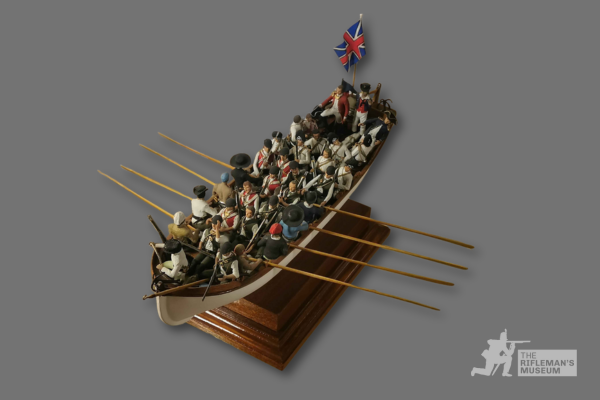
Item Details: Painted model of a ship’s boat crewed by sailors of the Royal Navy carrying soldiers, including those of the 60th (Royal Americans).
About the Item
This model, presented to the Museum by Edward Tuck and Emily Mills, shows the kind of ship’s boat typically used to row soldiers ashore during the capture of Havana, Cuba, from the Spanish in 1762—including soldiers of the 3rd Battalion, 60th Royal Americans, who can be seen in red. The boat is crewed by soldiers of the Royal Navy.
About the Siege of Havana
During the Seven Years’ War, Spain—previously neutral—entered the conflict by signing the Family Compact with France. In response, Britain declared war on Spain in January 1762. Havana, a major Spanish naval base, became an immediate target: by seizing it, Britain hoped to weaken Spanish influence in the West Indies and strengthen the security of its own American colonies.
The Spanish planned to delay any British assault until the seasonal rains, tropical diseases, and the onset of hurricane season could ravage the invading troops and force the fleet to withdraw. Yet a British Royal Navy force, escorting 160 troopships, approached Havana from an unexpected direction. They seized the Spanish fleet in the harbour and landed their troops. British forces soon occupied an unfortified hill overlooking Morro Castle, installed artillery batteries, and subjected the fortress to relentless daily bombardment. Morro Castle ultimately fell after its commander was mortally wounded by a stray round, and the city surrendered soon afterward.
Conditions for troops serving in the Caribbean were notoriously harsh. At least one battalion of the 60th Regiment served there almost continuously between 1762 and 1820, enduring intense heat, inadequate water, back-breaking labour, and rampant disease. Despite the defeat of the Spanish, their hopes to ravage the British troops were nevertheless fulfilled: 520 men were killed in action, but another 4700 to sickness.
The capture of Havana formed one of the 60th’s earliest battle honours, though the “Havannah” honour was not formally awarded until 1909.