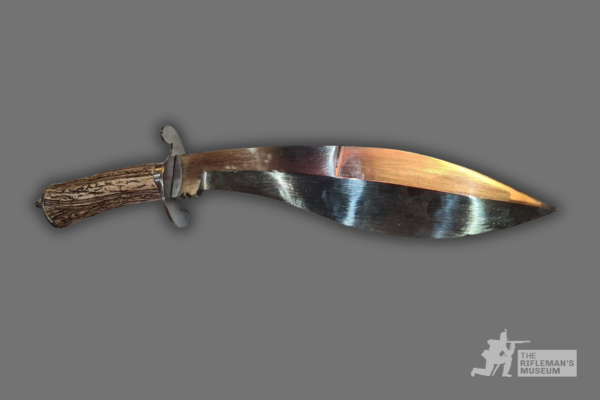
Item Details: A spring steel kukri with horn or antler handle
About the Item
This kukri was gifted to Captain Mortimer following his role in the capture of Delhi in 1857. During the assault, Mortimer was injured, and all the men of his section were killed or wounded. Such was the ferocity of the fighting that his sword broke during the action, and the Gurkhas of the Sirmoor battalion were so impressed by the young officer’s gallantry that they gifted him the knife in recognition of his leadership.
The kukri is the national weapon of Nepal, and is used as both a weapon and a tool. It has a distinctive blade shape with a curve in it, and a small notch at the base of the blade to prevent blood or sap from seeping down onto the handle.
About Captain Stanley Mortimer
Stanley Mortimer joined The King’s Royal Rifle Corps in 1856. In 1857 he took part in the storming of Delhi during The Indian Rebellion. He rose to the rank of Captain before retiring from the Army.
About The Indian Rebellion
The Indian Rebellion of 1857 was a major uprising against British East India Company rule, sparked by widespread resentment over British political interference, cultural and religious clashes, and military grievances. The rebellion was eventually suppressed, resulting in the dissolution of the East India Company and the transfer of India to Crown rule in 1858.
During the Siege of Delhi, the Sirmoor Battalion of Gurkhas fought alongside The King’s Royal Rifle Corps at Hund Rao’s House on the Delhi Ridge. Together, they endured repeated attacks during the three-month siege. Their shared courage formed a lasting regimental association. The King’s Royal Rifle Corps successfully petitioned for The Sirmoors to be converted into a rifle regiment. The next year in 1858, they became The Sirmoor Rifles, took on Rifleman traditions of green jackets, fast marching, and replaced their colours with ‘The Queen’s Truncheon’ inscribed with “Hindoo Rao’s House”.