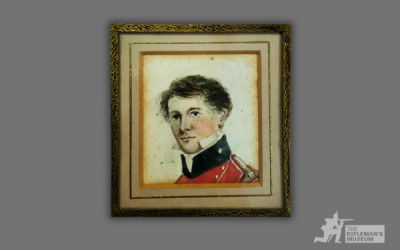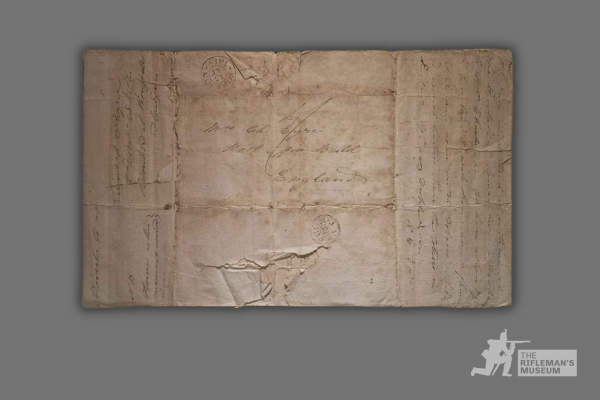
Item Details: Framed pages of a letter written by Lieutenant Richard Cocks Eyre, 2nd Battalion 95th Foot, dated 28th June 1815.
About the Item
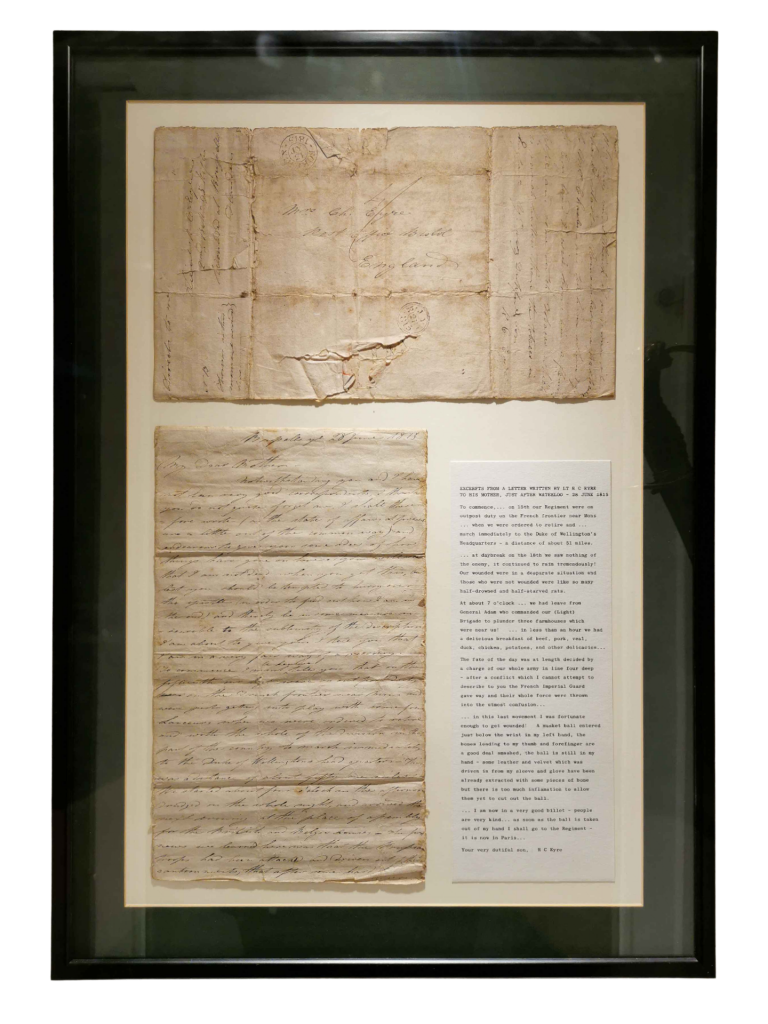
This letter was written by Lieutenant Richard Cocks Eyre of 2nd Battalion, 95th Foot to his mother, recounting his experience of the Battle of Waterloo, including his injury during the battle.
The pages of the letter have been framed with a selection of typed extracts for ease of reading.
The full letter reads as below. Line breaks have been added for ease of reading and are not present in the original letter.
Brussels, 28 June 1815
My dear Mother,
Notwithstanding you and I have not been very good correspondents, I think you do not quite forget me. I shall therefore write (as the state of affairs at present are a little out of the common way) and endeavour to give you some idea of how things have gone on here. You will see that I am not dead when you get this, but lest you should be tempted to hurry over the epistle (in order to find out how I am in the end) and thereby be in some measure insensible to the sublimity of the description I am about to give you, I tell you that I am in a very fair way of a recovery.
To commence I must likewise tell you that on the fifteenth our regiment were on outpost duty on the French frontier near Mons and were just getting into play with some French lancers when we were ordered to retire and with the whole of the division in that part of the country to march immediately to the Duke of Wellington’s headquarters, this was a distance of about fifty one miles! We started about four o’clock in the afternoon, trudged on the whole night and arrived the next evening at the place of assembly for the British and Belgian armies.
The first news we learned here was that the Prussian troops had been attacked and driven out of their cantonments, that after some hard fighting and the loss of some thousand prisoners they had retired upon the British army for support. We likewise found that our outposts (who kept up the communication with the right of the Prussian line) had been attacked and driven in, and that Lord Wellington had with the greatest difficulty checked the advance of the French upon Brussels, which he effected by lining a wood about ten miles in front of the town with those troops which composed its garrison, among which was our first battalion. The French army just then retired and we were ordered to follow them up and form a chain of sentries when they came to their position for the night. On the seventeenth we had some hard skirmishing but no general attack was made on either side. That night we remained in a wood in advance. At day break on 18th we saw nothing of the enemy, it continued (as it had done all night) to rain tremendously!
Our wounded were in a desperate situation, and those who were not wounded were like so many half drowned and half starved rats. At about seven o’clock however to our great satisfaction the skirmishers were called in, and as a reward for our nocturnal labours, we had leave from General Adam who commanded our (Light) Brigade to plunder three farm houses which were near us!
The idea of a fire was a most consoling one! Chairs, tables, sofas, cradles, churns, barrels and all manner of combustibles were soon cracking in the flames, our fellows then proceeded to the slaughter of all the living stock the yard contained, and in less that an hour we had as delicious a breakfast of beef, pork, veal, duck, chicken, potatoes and other delicacies as I ever made an attack upon. This repast was just finished and our fellows had got themselves thoroughly dry when we were ordered to fall in and proceed as fast as possible with the 52nd and 71st Regiments (which comprised our brigade) to the front to protect three brigades of artillery which were ordered out to the edge of the hill on which the British and Belgic armies had taken up their position.
About 11 o’clock a.m. the enemy commenced their attack with near three hundred pieces of cannon which they brought up in three different points, the whole of their fire was however directed to the point we occupied. Our cavalry then went to the front and was received in a warm manner by the enemy whose cavalry at this moment advanced to the amount of about thirty thousand! Our dragoons made some dashing charges, but from the immense superiority of numbers against them they were soon obliged to retire and make way for the advance of infantry.
Before the columns in the rear had time to come up, the whole of the French cavalry in our part of the field made an attack upon our artillery. Our fellows defended them in gallant style, our brigade was however terribly weakened! We had lost our general, and our regiment had lost three successive commanding officers (our two colonels and major). At this critical moment Lord Wellington sent the Guards and a brigade of the Brunswick Oels to support us. Soon after the repeated huzza’s and determined conduct of the British soldiers convinced the enemy that our position could not be carried. Some fresh supports again coming up obliged the French cavalry to take themselves off and we were ordered to charge which threw them into the greatest possible confusion.
About four o’clock we found that some divisions of Prussians had come up, made an attack, and turned the left flank of the enemy. Things then began to wear a more favourable appearance. The whole British and Belgic army came up in squares; the French cavalry which had by this time got into a little order, then made another charge and were beaten back with an immense loss without doing us any harm. As soon as they had cleared the way a second time our whole army formed line. The French Imperial Guards and the whole of their infantry advanced and (we flatter ourselves) were met in the most glorious style. The action was now become general and at its height.
The fate of the day was at length decided by a charge of our whole army in line four deep. After a conflict which I cannot attempt to describe to you the French Imperial Guards gave way and their whole force were thrown into the utmost confusion. We followed them (shouting and keeping up a tremendous fire of musketry, shells and rockets) about seven miles during which pursuit a scene presented itself which I think hell itself could not surpass; about dusk we came up to two villages which our rockets had set fire to, here the French thought they may easily check our pursuit and with that idea brought about their whole artillery which they commenced loading with grape and round shot and poured them in on us from all quarters, their infantry likewise kept up a destructive fire of musketry. If anything in the world would have damped the ardour of British troops this would have done it but their confidence in their general and encouraged as they were by success the devil himself would not have stopped them. They continued their huzzas and dashed through everything that opposed them.
We now came to an immense hill where we found the consternation of the routed enemy so great that all classes of them, dragoons, infantry and artillery were mixed in one immense and confused mass. The greater part of their infantry threw down their packs and arms to be able to mount the hi they were then endeavouring to get over. Those we came up to ran into us as prisoners. Our lines then shortened pace to allow our cavalry and light troops to make a flank movement and get round to the other side of the hill, by this we succeeded in taking a great number of prisoner, a great part of their artillery and the whole of their provision and ammunition wagons. It however gave us some hard work as the part of the French army we had cut off fought hard with the idea of joining their companions who were better at running than themselves. In this however they were foiled, and in this last movement (about half past nine at night) which gloriously concluded a well and hard fought day, I was fortunate enough to get wounded!
A musket ball entered just below the wrist in my left hand, the bones leading to my thumb and forefinger are a good deal smashed, the ball is still in my hand. Some leather and velvet which was driven in from my sleeve and glove have been already extracted but there is too much inflammation to allow them to cut out the ball. I am however assured that there is no danger of losing the hand and that I shall in great measure recover the use of it.
I have now given you a [full?] description of the fight and shall conclude by saying a little more of myself. When I was wounded it was dark, my friend Drummond (who you have heard me mention) got a man of the band to assist me to the rear in quest of a surgeon but after wandering as far as my strength would allow me I found the attempt to find one useless and therefore got the man who was with me to search for some blankets among the packs of the unfortunate fellows who were pretty thickly scattered about us and after getting well wrapped up laid down for the remainder of the night. In this situation I suffered the most excruciating pains. In the early part of the fight I was struck in the left knee by a piece of shell; whilst I kept myself in motion I felt very little from the blow which did not penetrate but after I had lain some time on the ground it gave me an immensity of pain as it was much swollen and perfectly stiff.
At day break on 19th Drummond found me out and to my unspeakable joy procured a dragoon horse that was slightly wounded to take me to Brussels. I shall not attempt to describe the scene which presented itself in retracing the ground we had fought over. The whole of the French wounded were not [still?] taken from the field 24th (six days after the action). We had fourteen companies here of our regiment 6 of the first, 6 of the second and 2 of the third, and had lost 38 officers in killed and wounded.
I have lost the whole of my baggage and horse in [piece missing-an attack?] by the French on the [17th?]. I am now in a very good billet. The people are very kind to me, they give me linen and clothes when I can get up. Give my love to [blank], to Will if you have an opportunity of writing to him and [illegible] you and [illegible] between you write me a long letter by return post. As soon as the ball is taken out of my hand I shall go to the regiment, it is now in Paris. You will see when I began this letter by the date, it is now 11th July and I think it is time t should start. Remember me to Mr Charles, and tell him when I go to England I will bring him a Flemish pipe and some Dutch tobacco which is much better than the tobacco in England. Your very dutiful son,
R.C. Eyre
Direct to me: Lieutenant R.C. Eyre 2nd Battalion 95th Rifles bounded at Brussels Flanders.
NB Thomas is this moment arrived here.
About Lieutenant R.C. Eyre
Richard Cocks Eyre was born c. 1794. He transferred to the 2nd Battalion 95th Foot on 22nd April 1814 from the East Middlesex Militia as a Lieutenant. He went on half pay in 1817, when he appears to have married Mary Anne Adams, a widow.
He died in 1841 at 47 years old, and was buried in the parish of St George, Gloucester, on April 3rd 1841.